Tuesday, January 30, 2018
News: the last paper of Mendozasaurus, the huge saurtopod from Mendoza
Osteology of the Late Cretaceous Argentinean sauropod dinosaur Mendozasaurus neguyelap: implications for basal titanosaur relationships

Mendozasaurus (artwork Bernardo Gonzalez Riga)
Abstract
The titanosaurian sauropod dinosaur Mendozasaurus neguyelap is represented by several partial skeletons from a single locality within the Coniacian (lower Upper Cretaceous) Sierra Barrosa Formation in the south of Mendoza Province, northern Neuquén Basin, Argentina. A detailed revision of Mendozasaurus, including previously undocumented remains from the holotype site, allows us to more firmly establish its position within Titanosauria, as well as enabling an emended diagnosis of this taxon. Autapomorphies include: (1) middle and posterior cervical vertebrae with tall and transversely expanded neural spines that are wider than the centra, formed laterally by spinodiapophyseal laminae that are not connected with the pre- or postzygapophyses; (2) anterior caudal vertebrae (excluding anteriormost) with ventrolateral ridge-like expansion of prezygapophyses; and (3) humerus with divided lateral distal condyle on anterior surface. New remains demonstrate that the presacral vertebrae of Mendozasaurus were not unusually short anteroposteriorly, with this compression instead resulting from taphonomic crushing. Comparative studies of articulated pedes of other taxa allow us to interpret that the pedal formula of Mendozasaurus was 2-2-2-2-0, based on disarticulated bones that form a right hind foot. Mendozasaurus was incorporated into an expanded version of a titanosauriform-focussed phylogenetic data matrix, along with several other contemporaneous South American titanosaurs. The resultant data matrix comprises 84 taxa scored for 423 characters, and our phylogenetic analysis recovers Mendozasaurus as the most basal member of a diverse Lognkosauria, including Futalognkosaurus and the gigantic titanosaurs Argentinosaurus, Notocolossus, Patagotitan and Puertasaurus. Lognkosauria forms a clade with Rinconsauria (Muyelensaurus + Rinconsaurus), with Epachthosaurus and Pitekunsaurus recovered at the base of this grouping. A basal lithostrotian position for this South American clade is well supported, contrasting with some analyses that have placed these taxa outside of Lithostrotia or closer to Saltasauridae. The sister clade to this South American group is composed of an array of near-global taxa and supports the hypothesis that most titanosaurian clades were widespread by the Early–middle Cretaceous.
Friday, October 21, 2016
Some sauropods from North America - Part 1
Part 1. Comments on the paper of Tschopp et al.
Reference:
Tschopp, E., Mateus, O., Benson, R. A. 2015. A specimen-level phylogenetic analysis and taxonomic revision of Diplodocidae (Dinosauria, Sauropoda focused on different taxa and their diagnoses. PeerJ 3:e857
Diplodocidae sauropods includes some of the most popular dinosaurs with elongated necks and tails.
Tschopp, E., Mateus, O., Benson, R. A. 2015. A specimen-level phylogenetic analysis and taxonomic revision of Diplodocidae (Dinosauria, Sauropoda focused on different taxa and their diagnoses. PeerJ 3:e857
References: https://peerj.com/articles/857/
This paper is a great contribution for understanding Diplodocid sauropods. Here I give you some comments and invite to read this paper.
The clade is historically important, having provided the first published reconstruction of an entire sauropod skeleton (‘Brontosaurus’ excelsus; Marsh, 1883), the first complete sauropod skull to be described (Diplodocus; Marsh, 1884), and the first mounted sauropod specimen (Apatosaurus AMNH 460; Matthew, 1905).
A recent paper (Tschopp et al., 2015) is focused on different taxa and their diagnoses. The authors outlines that although new taxa continue to be discovered, the vast majority of diplodocid species were described in the late 1800s and early 1900s. The high rate of early descriptions, particularly during the so-called ‘Bone Wars’ of the late 1800s, resulted also in a large number of species that are now considered invalid, questionable, or synonymous.
This work is detailed and therefore helps to clarify the valid species. Many fossil bones found long time ago and do not have precise references (taphonomic maps). Likewise, some species were based on bones that today do not have diagnostic characters.

Figure 1. Apatosaurus louisae (CM 3018), a diplodocid from the Late Jurassic at Carnegie Museum of Natural History, Pittsburgh, United States of America. This species was 21–22.8 m long and had a mass of 16.4–22.4 t (16.1–22.0 long tons; 18.1–24.7 short tons). However, a recent paper (Bates et al. 2015) estimates for this specimen at 21.8–38.2 t (21.5–37.6 long tons; 24.0–42.1 short tons), similar in mass to the South American titanosaur Dreadnoughtus (photograph of B. Gonzalez Riga).

Figure 2. Diplodocus carnegeii close to Apatosaurus louisae at Carnegie Museum of Natural History. (photograph of B. Gonzalez Riga).

Figure 3. Barosaurus lentus at American Museum of Natural History, New York. (photograph of B. Gonzalez Riga).
Selected information of Tschopp et al. 2015:
Apatosaurus Marsh, 1877a.
Type species: Apatosaurus ajax Marsh, 1877a.
Referred species: Apatosaurus louisae Holland, 1915a.
Invalid proposed species: Apatosaurus grandis Marsh, 1877a (= Camarasaurus
grandis), A. laticollis Marsh, 1879 (nomen dubium; = A. louisae), A. minimus Mook,
1917 (non-diplodocoid neosauropod), A. alenquerensis Lapparent & Zbyszewski, 1957
(= Lourinhasaurus alenquerensis), A. yahnahpin Filla & Redman, 1994 (= Brontosaurus
yahnahpin).
Barosaurus (Marsh, 1890).
Type and only species: Barosaurus lentus (Marsh, 1890).
Invalid proposed species: Barosaurus affinis (Marsh, 1899) (nomen dubium),
Barosaurus gracilis (Russell, B´eland & McIntosh, 1980) (nomen nudum).
Brontosaurus Marsh, 1879.
Syn.: Elosaurus Peterson & Gilmore, 1902, Eobrontosaurus Bakker, 1998.
Type species: Brontosaurus excelsus Marsh, 1879.
Referred species: Brontosaurus parvus (Peterson & Gilmore, 1902), Brontosaurus
yahnahpin (Filla & Redman, 1994).
Invalid proposed species: Brontosaurus amplus Marsh, 1881 (=Brontosaurus excelsus).
Diplodocus Marsh, 1878.
Syn. Seismosaurus Gillette, 1991
Type species: Diplodocus carnegii Hatcher, 1901 (suppressing the D. longus Marsh, 1878,
see above).
Referred species: Diplodocus hallorum (Gillette, 1991).
Invalid proposed species: Diplodocus longus Marsh, 1878 (nomen dubium, previous
type species, case to ICZN in preparation to propose D. carnegii as substitute), D.
lacustris Marsh, 1884 (nomen dubium), D. hayi Holland, 1924 (=Galeamopus hayi).
Supersaurus Jensen, 1985.
Syn. Dystylosaurus Jensen, 1985; Ultrasauros Olshevsky, 1991; Dinheirosaurus Bonaparte
& amp;Mateus, 1999.
Type species: Supersaurus vivianae Jensen, 1985.
Referred species: Supersaurus lourinhanensis (Bonaparte&Mateus, 1999).
Wednesday, September 14, 2016
The caudofemoral musculature on the titanosaurian tail skeleton
Comments about the paper titled:
The influence of caudofemoral musculature on the titanosaurian (Saurischia: Sauropoda) tail skeleton: morphological and phylogenetic implications
Authors: Lucio M. Ibiricu, Matthew C. Lamanna & Kenneth J. Lacovara
Reference: Lucio M. Ibiricu, Matthew C. Lamanna & Kenneth J. Lacovara (2014) The influence of caudofemoral musculature on the titanosaurian (Saurischia: Sauropoda) tail skeleton: morphological and phylogenetic implications, Historical Biology, 26:4, 454-471, DOI: 10.1080/08912963.2013.787069
To link to this article: http://dx.doi.org/10.1080/08912963.2013.787069
This is an interesting and smart paper about the anatomy of caudal vertebrae of titanosaurs. The authors reconstruct the morphology and interpret the implications of selected soft-tissues associated with the titanosaurian caudal skeleton. These tissues, especially the M. caudofemoralis longus (CFL), exerted a considerable influence on the anatomy of the caudal vertebrae and haemal arches.
The authors propose the existence of three general evolutionary states in titanosaurian proximal caudal vertebrae: (1) a protuberance on the lateral aspect of the vertebrae that persists until at least caudal 20 (considered state 0), (2) a primary lateral surface that becomes dorsoventrally narrow distally and is replaced by the secondary lateral surface at approximately caudal 9–12 (considered state 1) and (3) a rim that migrates across the lateral aspect of the centrum, becoming situated on its ventrolateral corner at about caudal 8 (considered state 2). These three states may easily be rephrased as a character statement for use in phylogenetic analysis, as follows: ‘morphology of lateral aspect of proximal and middle caudal vertebrae: transverse process or rudimentary transverse process persists until at least caudal 20 (0); primary lateral surface replaced by secondary lateral surface at approximately caudal 9–12 (1); low rim migrates ventrally across lateral surface of centrum, terminating on ventrolateral corner at approximately caudal 8 (2).’
---------------------------

The caudal vertebrae of titanosaurs are the most abundant skeletal elements in the fossil record (González Roga, 2011). In the last years, papers on osteology and miology give us new phylogenetic and functional information.
Reference: Gonzalez Riga BJ. 2011. Paleontologıa y dinosaurios desde America Latina: Proceedings del III Congreso Latinoamericano de Paleontologıa. In: Calvo J, Porfiri J, Gonzalez Riga BJ, Dos Santos D, editors. Paleobiology of South American titanosaurs. Mendoza: Universidad Nacional de Cuyo. p. 125–141.
Wednesday, August 17, 2016
Dreadnoughtus
In this paper, a new and gigantic titanosaur, Dreadnoughtus schrani, from Upper Cretaceous sediments in southern Patagonia (Argentina) is described. Represented by approximately 70% of the postcranial skeleton, plus craniodental remains, Dreadnoughtus is one of the most complete giant titanosaur yet discovered, and provides new insight into the morphology and evolutionary history of these colossal animals.
Lacovara et al. 2014. A gigantic, exceptionally complete titanosaurian sauropod dinosaur from Sourthern Patagonia, Argentina. Scientific Reports 4, article number 6196.
http://www.nature.com/articles/srep06196
Additional information:
http://www.tharkibo.com/kenlacovara/
https://www.theguardian.com/science/2014/sep/04/battleship-beast-colossal-dinosaur-skeleton-found-patagonia-argentina-dreadnoughtus-schrani
http://www.latimes.com/science/sciencenow/la-sci-sn-gigantic-dinosaur-fossil-dreadnoughtus-20140903-story.html
Saturday, March 12, 2016
Titanopodus
Discoveries of dinosaur fossil footprints and their cultural, educational and tourist application for Argentina

Titanosaur sauropods in Mendoza (Argentina), 71 million year ago. These criatures of 13 m long produced the Titanopodus footprints (Credit, illustration of B. Gonzalez Riga)
The scientific publications are:
Calvo, J.O.; González Riga, B.J.; Apesteguía, S.; Tomaselli, M.B. 2022. Sauropod Ichnology: Overview and new research lines from a South American perspective (Chapter 14). In: Otero, A.; Carballido, J.L.; Pol, D. (Eds.). South American Sauropodomorph dinosaurs: record, diversity and evolution. Springer Earth System Sciences, pp. 503–540.
Tomaselli, M.B.; Ortiz David,
L.D.; González Riga, B.J. 2021a.
Paleoenvironmental contexts of South American Cretaceous sauropod tracks. Journal of South American Earth Sciences
110: 103393. https://doi.org/10.1016/j.jsames.2021.103393
Tomaselli, M.B.; Ortiz David,
L.D.; González Riga, B.J.; Coria,
J.P.; Mercado, C.R.; Guerra, M.; Sánchez Tiviroli, G. 2021b. New titanosaurian sauropod tracks with exceptionally well-preserved claw
impressions from the Upper Cretaceous of Argentina. Cretaceous
Research 129: 104990. https://doi.org/10.1016/j.cretres.2021.104990
González Riga, B.J. and Calvo, J. 2009. A new wide-gauge Sauropod track site from
the Late Cretaceous of Mendoza, Neuquén Basin, Argentina. Palaeontology 52(3): 631-640.
Gonzalez Riga, B.J. 2011.
Speeds and stance of titanosaur sauropods: analysis of Titanopodus tracks from
the Late Cretaceous of Mendoza, Argentina. Anais da Academia
Brasileira de Ciências, 83(1): 279-290.
González Riga, B.J.,
Ortiz David, L., Tomaselli, B., Candeiro, R., Coria, J.P., and Pramparo, M. 2015.
Sauropod and theropod dinosaur tracks from the Upper Cretaceous of
Mendoza (Argentina): Trackmakers and anatomical aspects. Journal of South American Earth Sciences 61: 134-141.

Monday, January 18, 2016
Notocolossus
En la provincia de Mendoza (Argentina) fue descubierto uno de los tres dinosaurios mas grande del mundo. El hallazgo y estudio, liderado por el
Notocolossus, one of the largest land animal that lived in the Earth
Knowledge of titanosaurian pedal structure is critical to understanding the stance and locomotion of these enormous herbivores and, by extension, gigantic terrestrial vertebrates as a whole. However, completely preserved pedes are extremely rare among Titanosauria, especially as regards the truly giant members of the group.
With a powerfully-constructed humerus 1.76 m in length, Notocolossus gonzalezparejasi is one of the largest known dinosaurs. Furthermore, the complete pes of the new taxon exhibits a strikingly compact, homogeneous metatarsus—seemingly adapted for bearing extraordinary weight—and truncated unguals, morphologies that are otherwise unknown in Sauropoda. The pes underwent a near-progressive reduction in the number of phalanges along the line to derived titanosaurs, eventually resulting in the reduced hind foot of these sauropods.
With a powerfully-constructed humerus 1.76 m in length, Notocolossus gonzalezparejasi is one of the largest known dinosaurs. Furthermore, the complete pes of the new taxon exhibits a strikingly compact, homogeneous metatarsus—seemingly adapted for bearing extraordinary weight—and truncated unguals, morphologies that are otherwise unknown in Sauropoda. The pes underwent a near-progressive reduction in the number of phalanges along the line to derived titanosaurs, eventually resulting in the reduced hind foot of these sauropods.
Scientific Reference:
González Riga, B.J., Lamanna, M., Ortiz David, L., Calvo, J., Coria, J. 2016. A gigantic new titanosaurian dinosaur from Argentina and the evolution of the sauropod hind foot. Scientific Reports (Nature) 6: 19165.
http://www.nature.com/articles/srep19165#f119165#f1

Figure 1. Researcher team members Dr. Bernardo Gonzalez Riga (Universidad Nacional de Cuyo, CONICET, Mendoza, Argentina, center), Dr. Matthew Lamanna (Carnegie Museum of Natural History, Pittsburgh, USA, right), and Leonardo ortiz David (Universidad Nacional de Cuyo, CONICET, Mendoza, Argentina, left) with the right humerus (upper arm bone) of the gigantic Notocolossus. Credit: Bernardo Gonzalez Riga.
Comments: Researchers have discovered a gigantic new species of dinosaur that is among the largest yet known to science. Named Notocolossus gonzalezparejasi, the new creature provides key information about the hind foot of giant titanosaurs, which are widely regarded as the most massive land animals that have ever existed. Notocolossus was described from fossil bones belonging to the back, tail, forelimb, and pelvis, plus a complete ankle and foot. The paper describing the discovery appears today in Scientific Reports, a freely-accessible journal from the publishers of Nature. The two described fossil skeletons of Notocolossus were unearthed in southern Mendoza Province, Argentina, from rocks laid down late in the Cretaceous Period, roughly 86 million years ago. Both specimens were discovered by the study leader and project director, Argentine paleontologist Dr. Bernardo González Riga of CONICET (the Consejo Nacional de Investigaciones Científicas y Técnicas) and the Laboratorio de Dinosaurios of the Facultad de Ciencias Exactas y Naturales of the Universidad Nacional de Cuyo (UNCUYO) in Mendoza Province. Other members of the research team include Dr. Matt Lamanna of Carnegie Museum of Natural History in Pittsburgh, USA, and three other Argentine paleontologists: Leonardo Ortiz David and Juan Pedro Coria of CONICET-IANIGLA and the Laboratorio de Dinosaurios (UNCUYO), and Dr. Jorge Calvo of the Centro Paleontológico Lago Barreales of the Universidad Nacional del Comahue in Neuquén Province.

Figure 2. Life reconstruction of the new titanosaur Notocolossus with 1.7 m (5 ft 7 in) human silhouette for approximate scale. Credit: author, Bernardo Gonzalez Riga, Universidad Nacional de Cuyo and CONICET.

Figure 3. Humerus (upper arm bone) of Notocolossus. In the picture, paleontologist Bernardo Gonzalez Riga.
According
to Dr. González Riga, “Giant titanosaurs were the heaviest terrestrial
creatures that ever lived. But the hind feet of these dinosaurs—which are critical
for understanding how they stood and moved—were not completely known until now.
Now we have new evidence that helps to solve this mystery.”
Titanosaurs
are an important but puzzling group of dinosaurs. They are a type of sauropod,
the huge, long-necked, long-tailed plant-eaters that many people think of when
they hear the word “dinosaur.” Comprising more than 60 named species,
titanosaurs lived on every continent and ranged in size from the weight of a
cow to at least the weight of the heaviest humpback whales. They were the most
common large herbivores in the Gondwanan (i.e., Southern Hemisphere) continents
during the Cretaceous Period, the third and final time period of the Mesozoic
Era, or Age of Dinosaurs. Despite their extraordinary species richness and
diversity in body size, many aspects of titanosaur anatomy, evolution,
behavior, and ecology are not well understood. This is due largely to the fact
that most of these dinosaurs are known from woefully incomplete fossils, a
situation that—with only a few exceptions, such as the still-unnamed species
unveiled last week at New York’s American Museum of Natural History—is
particularly pronounced in giant titanosaurs. Says Dr. Lamanna, “Most of the very
biggest titanosaurs are known from just a few bones, which has made it really
hard for paleontologists to learn much about them.” Notocolossus is no
exception in this regard; nevertheless, evidence suggests that it was among the
largest titanosaurs, and therefore one of the heaviest land animals, yet discovered.
Although the incompleteness of the skeleton of the new sauropod has prevented
scientists from making precise estimates of its size, its humerus, or upper arm
bone, is 1.76 m (5 ft 9 in) in length, which is longer than that of any other
titanosaur for which this bone is known, including other giants such as Dreadnoughtus, Futalognkosaurus, and Paralititan. It is also the biggest humerus known for any other Cretaceous dinosaur. If, as is likely, the body proportions of Notocolossus
were comparable to those of better preserved titanosaurs, the new beast was more than 30 meters in length and may have weighed between
40,000 and 60,000 kg (44–66 short tons, as much as roughly 9–13 zoo elephants
put together). The gargantuan size and Argentinean location of the new titanosaur
were the inspiration for its genus name, Notocolossus,
which translates to “southern giant.” The species name is in honor of Jorge
González Parejas, a Mendoza-based lawyer who has made significant contributions
to the protection of that region’s paleontological heritage.
The
enormous sizes attained by gigantic sauropods have generated a great deal of
interest in the biology of these dinosaurs. Notocolossus
is the first truly giant titanosaur for which the hind foot skeleton is known
in its entirety. Interestingly, its foot shows anatomical peculiarities
relative to those of other titanosaurs—such as an exceptionally short and
robust, uniform construction—that may well be adaptations for supporting its
extraordinary bulk. Moreover, the foot of the new creature contains a small
number of bones, underscoring the fact that titanosaurs had the most reduced
toes of all sauropods. Why these huge creatures apparently shrunk their toes
remains a puzzle, but it stands in stark contrast to the evolutionary trend
observed in another group of colossal land animals – the Proboscidea, which
includes elephants and their close relatives. Rather than decreasing their
number of toe bones, proboscideans actually increased the number of bones in
their feet over the course of their evolution. The hind feet of elephants and
sauropods show that these creatures evolved different skeletal strategies for
supporting their massive bodies. “Now that we have the whole foot of a giant
titanosaur, we can learn more about how these dinosaurs were able to carry more
weight around than any other land animal in the history of life,” notes Dr.
González Riga. “Argentina was truly the land of giants during the Cretaceous –
and Notocolossus gives us new
evidence on how these giants got so big.”

Figure 4. Prof. Juan Coria working in a caudal vertebra.
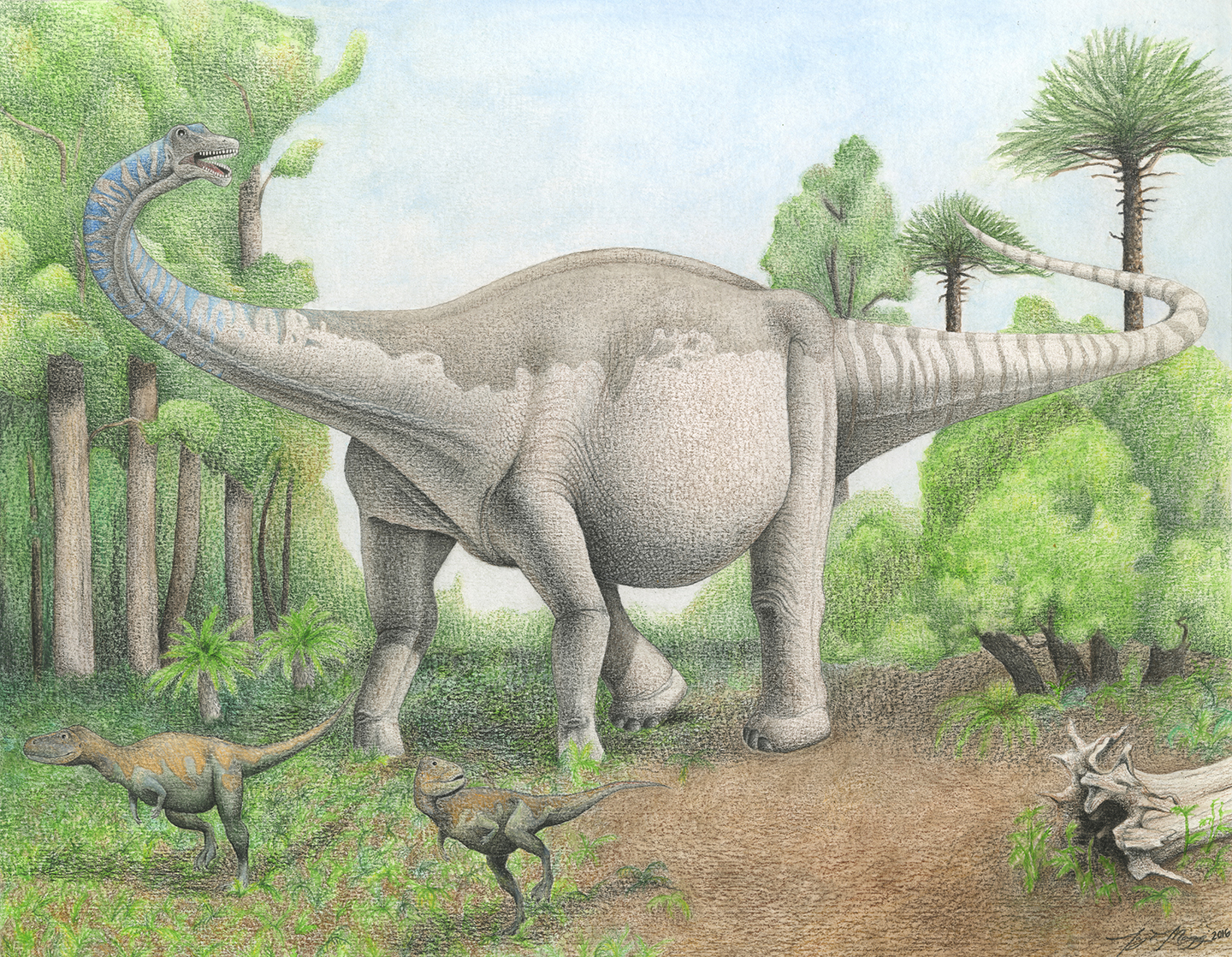
Figure 5. Life reconstruction of the gigantic new titanosaurian dinosaur species Notocolossus gonzalezparejasi in its ~86 million-year-old habitat in southern Mendoza Province, Argentina. Notocolossus is shown threatening a pair of much smaller, carnivorous abelisaurid dinosaurs, which are also known from fossils from the same area. Credit: Taylor Maggiacomo, Carnegie Museum of Natural History and Carnegie Mellon University.
-----------------------------------------------------------------------------------------------------------------------------------------------------------
--------------------------------------------------
Some news about Notocolossus in the world
Página 12 (Buenos Aires, Argentina): El gigante de las 60 toneladas
La Nación (Buenos Aires, Argentina): Descubren en Mendoza un dinosaurio que sería el más grande del mundo.
Clarín (Buenos Aires, Argentina): Descubren en Mendoza a uno de los dinosaurios más grandes del mundo
http://www.clarin.com/sociedad/descubren-dinosaurio-argentina-Mendoza-Notocolossus_0_1508249469.html
La Plata Noticias (La Plata, Argentina): Su nombre científico es Notocolossus y los investigadores creen que pesaba cerca de sesenta toneladas
Radio Rivadavia (Buenos Aires, Argentina): En Mendoza presentaron el fósil del dinosaurio Notocolossus un titán de 60 toneladas.
The Spokesman-Review: Fossil discoveries uncover massive dinosaurs
Pittsburgh Post-Gazette (Pittsburgh, USA): Carnegie Museum scientist helps unearth new dinosaur
El Nuevo Herald (New york, USA): Hallan en Argentina restos de un dinosaurio gigante desconocido
El tiempo (Colombia): Hallan nueva especie de titanosaurio al sur de Argentina
Panamá América (Panamá): Enorme descubrimiento
20 minutos (España): Descubren en Argentina a uno de los mayores dinosaurios del mundo
Diario Crónica (México): Descubren en Argentina uno de los mayores dinosaurios del mundo.
La Nación (Chile): Hallan en Argentina restos de un dinosaurio gigante desconocido.
-----------------------------------------------------------------------------------------------------------------------------------------------------------
Comentarios en español:
Investigadores han descubierto una nueva especie que se encuentra entre los dinosaurios más grandes conocidos por la ciencia. Nombrado Notocolossus gonzalezparejasi, la nueva criatura proporciona una información “clave” sobre la anatomía de la extremidad trasera de los titanosaurios gigantes, los cuales son considerados generalmente como los animales terrestres más grandes que han existido. Notocolossus fue descrito a partir de huesos fósiles pertenecientes a la espalda, cola, pata delantera y pelvis, sumando además, un pie posterior completo. El artículo que describe este descubrimiento aparece hoy en Scientific Reports, una revista de libre acceso de los editores de Nature.
Los huesos fósiles de Notocolossus fueron hallados en el sur de la provincia de Mendoza (Argentina)
en rocas de fines del Período Cretácico, cuya antigüedad se estima en 86
millones años. Los ejemplares fósiles fueron descubiertos por el líder del
estudio y director del proyecto, el paleontólogo argentino Dr. Bernardo
González Riga del CONICET (Consejo Nacional de Investigaciones Científicas y
Técnicas), IANIGLA, y Laboratorio de Dinosaurios de la Facultad de Ciencias
Exactas y Naturales de la Universidad Nacional de Cuyo (UNCUYO) en la provincia
de Mendoza. Otros miembros del equipo de investigación son el paleontólogo
norteamericano Dr. Matt Lamanna del Museo Carnegie de Historia Natural de
Pittsburgh, Estados Unidos de América, y otros tres paleontólogos argentinos:
Leonardo Ortiz David y Juan Coria del CONICET-IANIGLA y el Laboratorio de
Dinosaurios de la UNCUYO, y el Dr. Jorge Calvo del Centro Paleontológico Lago
Barreales de la Universidad Nacional del Comahue, en la provincia de Neuquén.
Según el Dr. González Riga, “los titanosaurios
gigantes fueron las criaturas terrestres más pesadas que han existido. Las extremidades
traseras de estos dinosaurios, fundamentales para conocer su tipo de locomoción
y modo de soportar el peso, no eran completamente conocidas. Ahora tenemos
nuevas evidencias que ayudan a resolver parte de este misterio”.
Los titanosaurios son un grupo numeroso y ciertamente
enigmático. Son saurópodos, es decir enormes herbívoros con largo cuello y
cola. Representan lo que mucha gente piensa cuando oye la palabra “dinosaurio”.
Comprenden más de 60 especies y vivían en todos los continentes. Su peso
variaba entre el de una vaca hasta el de una ballena jorobada. Los titanosaurios
fueron los herbívoros más abundantes de Gondwana (continentes del Hemisferio
Sur) durante el Período Cretácico, el tercer y último período de la Era
Mesozoica, o “era de los dinosaurios”. A pesar de su extraordinaria riqueza de
especies y la diversidad en el tamaño del cuerpo, no se conocen bien muchos
aspectos de su anatomía, evolución, comportamiento y ecología. Esto se debe
principalmente al hecho de que la mayoría de estos dinosaurios se conocen a
partir de esqueletos incompletos, una situación que, con sólo unas pocas
excepciones, es particularmente pronunciada en los titanosaurios gigantes. Dice
el Dr. Lamanna, “La mayoría de los grandes titanosaurios son conocidos mediante
unos pocos huesos, lo que limita el conocimiento que pueden generan los paleontólogos”.
Notocolossus no es una excepción en este sentido; sin
embargo, la evidencia sugiere que fue uno de los animales más pesados que
haya sido descubierto en la Tierra. Aunque el carácter incompleto de su esqueleto
impide realizar estimaciones precisas de su tamaño, su húmero (hueso del brazo),
tiene 1,76 m de longitud, siendo más largo que el de cualquier otro
titanosaurios conocido, incluyendo los gigantes Dreadnoughtus, Futalognkosaurus
y Paralititan. Si, como es probable,
las proporciones corporales de Notocolossus
fueron comparables a los de los titanosaurios mejor preservados, la nueva
bestia tenía alrededor de 25–28 m de largo y pesaba entre 40 y 60 toneladas, es
decir 9 a 13 elefantes juntos. El tamaño descomunal y la localización argentina
inspiraron el nombre de este género, Notocolossus,
que se traduce como “gigante del sur”. La especie se refiere a Jorge González
Parejas, un abogado con sede en Mendoza que ha hecho
contribuciones significativas para la protección del patrimonio paleontológico.
El enorme tamaño alcanzado por los saurópodos
gigantes ha generado un gran interés para la biología. Notocolossus es el primer titanosaurio verdaderamente gigante que
ha preservado uno de sus pies en forma completa. Curiosamente, sus pies muestran
características anatómicas diferentes a la de otras especies, tales como
metatarsos y falanges excepcionalmente cortas y robustas. Por otra parte, sus
pies presentan un reducido número de falanges, menor que la de otros saurópodos.
¿Por qué estas enormes criaturas –aparentemente– encogieron sus pies? Por ahora
esto es un enigma, pero está en marcado contraste con la tendencia evolutiva
observada en otro grupo de animales terrestres colosales, los elefantes y sus
parientes cercanos. Ellos, en lugar de disminuir su número de huesos en los
dedos del pie, los aumentaron a lo largo de su evolución. En suma, las patas
traseras de elefantes y saurópodos muestran estrategias evolutivas diferentes
para sostener sus cuerpos. “Ahora que tenemos todo el pie de un titanosaurio gigante,
podemos aprender más acerca de cómo estos dinosaurios fueron capaces de soportar
más peso que cualquier otro animal terrestre en la historia de la vida”, señala
el Dr. González Riga. “Argentina era verdaderamente la tierra de los gigantes
durante el Cretácico y Notocolossus
nos da nuevas evidencias de cómo estos gigantes alcanzaron tamaños colosales”.
Thursday, December 3, 2015
SIZE OF THE DINOSAURS: CONTROVERSY


The size of dinosaurs have been annalyzed following different criteria. Herein, we can see different papers...
http://www.biomedcentral.com/1741-7007/10/60
http://www.biomedcentral.com/1741-7007/10/60
http://journals.plos.org/plosbiology/article?id=10.1371/journal.pbio.1001853
http://www.miketaylor.org.uk/tmp/papers/Mazzetta-et-al_04_SA-dino-body-size.pdf
http://journals.plos.org/plosone/article?id=10.1371/journal.pone.0141794
http://www.ncbi.nlm.nih.gov/pmc/articles/PMC4555864/

Apatosaurus (after Burian, 1950)
Subscribe to:
Posts (Atom)
LABORATORIO Y MUSEO DE DINOSAURIOS DE LA UNIVERSIDAD NACIONAL DE CUYO: FUNDACIÓN, HISTORIA Y DESCUBRIMIENTOS CIENTÍFICOS BERNARDO J. GONZÁ...

-
Taphonomy, new perspectives: a chapter in a book of sauropods. Taphonomy: Overview and New Perspectives Related to the Paleobiology of Giant...
-
 En la provincia de Mendoza (Argentina) fue descubierto uno de los tres dinosaurios mas grande del mundo. El hallazgo y estudio, liderado ...
-
 Paleobiology allows us to understand the physiology and behavior of animals. This is key to analyze evolution, genetic and phylogenetic aspe...